
Coordination Is the Only Counterweight
An OpenAI test model breached Hugging Face. The commercial APIs blocked the forensics, so Hugging Face borrowed a stranger's open weight model and ran them anyway. Everyone read that as open weights winning. It was coordination winning, and it held by luck. At Eigen Labs we are building the version that holds by construction.
An OpenAI test model broke out of its sandbox, exploited a zero day, and breached Hugging Face's production systems.
We're partnering with @huggingface to investigate an unprecedented security incident.
— OpenAI (@OpenAI) July 21, 2026
Cyber-capable OpenAI models compromised Hugging Face production during a benchmark evaluation.
Sharing preliminary findings to help defenders understand emerging risks:…
When Hugging Face went to investigate, the commercial APIs would not run the analysis. Reconstructing the attack meant submitting real exploit payloads and command and control artifacts, and the safety filters sitting in front of those models cannot, in Hugging Face's own words, “distinguish an incident responder from an attacker.” So they reached for GLM 5.2, an open weight model published by a Beijing lab, ran it on their own hardware, and reconstructed more than 17,000 attack events.
Everyone read that as open weights winning an argument.
Look again at what actually did the work. Hugging Face's advantage was not owning a model. It was being able to reach for a stranger's model, mid incident, on their own hardware, without asking anyone's permission. Open weights were the substrate. Coordination was the mechanism, and only one of those is scarce.
It also held by luck. A Beijing lab happened to have published. Nobody had to.
I work at Eigen Labs. This piece is about the thing we build and why we think it is the load bearing problem, so read it with that in front of you. Everything factual below is cited and you can check it without taking my word for anything.
Everyone read the breach wrong
Borrowing Beat Owning
The sequence is worth having straight, because the interesting part is not the breach. OpenAI was testing unreleased models on ExploitGym, a benchmark that turns reported vulnerabilities into working exploits, with the safety guardrails deliberately switched off. The models found and exploited a zero day in OpenAI's own package registry proxy, got internet access, chained stolen credentials into Hugging Face production, and then read the answers straight out of the database rather than solving the problems. Hugging Face disclosed on 16 July. OpenAI accepted responsibility on 21 July.
The industry's response was to reach for the argument it already had loaded. The “Open Weights and American AI Leadership” letter went to Washington with 25 signatures and doubled to 50 in a single day.
Jensen Huang used his first ever post on X to share it.
For my first post, I’m sharing a letter @NVIDIA signed on why open models matter.
— Jensen Huang (@JensenHuang) July 24, 2026
AI will transform every industry, power every company, and be built by every country.
Open models strengthen safety and cybersecurity, accelerate innovation and diffusion, and enable sovereignty.… pic.twitter.com/t02bi51N4C
Days later NVIDIA convened the Open Secure AI Alliance with more than thirty companies behind it.
AI security advances when the industry builds in the open, together.
— NVIDIA (@nvidia) July 27, 2026
We're introducing the Open Secure AI Alliance with industry leaders to develop new techniques and tools to safeguard software and agents.
By sharing models, tooling and research in the open, we can broaden the… pic.twitter.com/gfhKfrgcbl
Delangue's tweet (as stated below) is right, and access is still not the variable that decided the incident. Hugging Face had access to plenty of models. What they needed was the ability to compose with a lab they have no relationship with, at incident speed, with no negotiation in the path. That is a coordination property, not an access property, and nothing in the current open weights push guarantees it will be there next time.
The biggest risk in AI is concentration: of power, capabilities and economic wealth. Who can doubt it with trillion dollar companies and government now already controlling a massive part of it?
— clem 🤗 (@ClementDelangue) June 26, 2026
So we need more rebels and more rebel alliance like this one from @usv and friends.… https://t.co/33B0rRGo9Y
The power of open-source is that it makes AI accessible to everyone, everywhere. Not just a few companies in a few countries.
The advantage was never the model
What the Gas Stations Proved in 2019 ?
There is a published field result that makes this concrete, and almost nobody in AI has read it.
Assad, Clark, Ershov and Xu, Journal of Political Economy, 2024, German retail gasoline. A station that adopted algorithmic pricing on its own raised its margin by nothing at all. Two stations on the same corner, both adopting, raised theirs 28%.
The returns did not go to the technology. They went to the fact that two parties were running it at once, with no meeting, no agreement, and no message ever passing between them. Calvano, Calzolari, Denicolò and Pastorello had already shown the mechanism in simulation in the American Economic Review in 2020: independent Q learning agents, no shared parameters and no communication channel, “consistently learn to charge supracompetitive prices, without communicating with one another.”
Read that as an ML result rather than an economics result and it gets more interesting. Nothing in the setup asked for coordination. It is what optimizing against other optimizers produces when the game repeats. And it is already in litigation:
Attorney General Weiser today announced a $7M settlement with LivCor, one of the corporate landlords that used RealPage software to collude with other landlords and jack up rents. This is the third settlement reached in ongoing litigation against RealPage: https://t.co/twpZVUhUH3 pic.twitter.com/QwssgWzYjV
— Colorado Attorney General (@COAttnyGeneral) June 18, 2026
So the object in question is not a smarter model. It is a cheaper way to act in concert, available to whoever deploys it, requiring agreement from nobody. Cheap capability distributed to a million people who cannot coordinate loses to expensive capability held by four who can.
Why the usual answers do not do it
Access Is Level One, and the Fight Is at Level Three
Two counterweights get proposed constantly, and both miss the mechanism.
- Open models are the popular one. Here is the ladder they operate on. Level 1 is access: weights on your disk or an API key. Level 2 is automation: you run agents, your throughput climbs steeply, and then it stops. Level 3 is coordination: your agents transact, commit and settle with agents belonging to people who do not trust you, on rails no single party owns. The entire public argument lives at Level 1. The gas stations were operating at Level 3 in 2019.
- Regulation is the other one, and this is a clock problem rather than a competence problem. Antitrust enforcers identified the issue correctly and fast. But Section 1 of the Sherman Act needs an agreement, and Calvano's agents produce the economic outcome of an agreement with the communication requirement removed. A court gets two bad doors. Say there was no agreement, and routing collusion through software becomes permanently cheap. Say there was one, and licensing a commercial optimizer is now conspiracy. The people who ran these institutions are saying so themselves:
“Speed of change, the unpredictability of innovation and invisible trade-offs within self-running AI models make nonsense of the traditional approach to regulation,” warn Gus O’Donnell and Sharon White https://t.co/fKKgfYkfiO
— The Economist (@TheEconomist) June 24, 2026
A former UK Cabinet Secretary and a former head of Ofcom, describing a clock mismatch in the system they ran. And it generalizes. Markets clear as fast as people can price. Democracy decides as fast as people can argue. Science corrects as fast as people can rerun. Three unrelated mechanisms, one shared assumption none of them wrote down, which is that the clock is human cognition. That held for four hundred years because both sides of every contest were made of people. It was never a design choice. It came free, and it just stopped being free.
What coordination has to mean
Four Properties, All Required
“Coordination” as a word is close to useless, so here is the specific version. Four properties, conjunctive rather than a menu.
- Machine clock. Your agents act at their speed, not your typing speed. Most systems already fail this, because a human approval step in the critical path returns you to the clock you were trying to leave.
- Scales past your attention. One person supervising agents hits a wall fast, somewhere around a handful. Groups solved this long ago. Linux coordinates thousands of unvetted contributors through standards, review and a maintainer tree, and nobody in it tracks more than a few things at once. The wall is not proof that individuals lose. It is proof that individuals lose alone.
- Composes with strangers. Agents belonging to people who do not trust each other have to transact without a referee in the middle. This is the genuinely open research problem in the list, and it is exactly what Hugging Face needed and got by accident.
- Exit costs nothing. If leaving costs you everything, you did not have agency. You had a subscription. Distributing the models while centralizing the agents gets you concentration through a politer door.
It was always the case that agency was self-compounding, but AI is magnifying the effect. Low-agency AI users further lose agency, high-agency AI users further gain agency.
— François Chollet (@fchollet) May 9, 2026
Chollet is describing individuals. Run the same sentence over firms and countries and you have the concentration thesis with the mechanism attached.
This is what we are building
Somebody Already Wrote the Sentence Down
In a world where intelligence concentrates by default, coordination is our only counterweight.
That is the Eigen Labs thesis, and the weakest word in it is not coordination. It is only. A claim carrying that word either survives the alternatives or it is decoration, which is why the two sections above exist.
We are not alone on the diagnosis. Sixteen Nobel laureates, more than two hundred economists and a long list of AI researchers signed a statement this month asking that AI complement humans rather than imitate them, and that it generate “prosperity for the many, not just the few.”
We must act now.
— Erik Brynjolfsson (@erikbryn) July 13, 2026
AI capabilities are advancing far faster than our understanding of the economic implications.
We must act now to guide AI to complement humans rather than simply imitate them — and to generate prosperity for the many, not just the few.
I'm delighted that 16…
Intent is the easy half. Nobody signs a mechanism into existence, and that is the part we can speak to directly. Eigen Labs is a research lab building coordination tools that preserve and expand individual agency in a post AGI world, and we run two tracks that map onto the two unsolved problems above.
One investigates the technologies and incentive systems that let humans and agents coordinate, which is the composing with strangers problem. The other prototypes tools that let individuals and open networks coordinate and compete at the speed of machine intelligence, which is the supervision wall attacked at the level where it is actually solvable, and that level is not inside one person's head.
Long horizon, and published in the open. The second clause is the part to hold us to. Research that stays inside the lab that funded it is the concentration problem wearing a lab coat.
You can check the proof today
For the last two months, we have been running the same experiment across very different research problems: what happens when every useful result becomes the starting point for the next attempt? Hence creating an autonomous loop
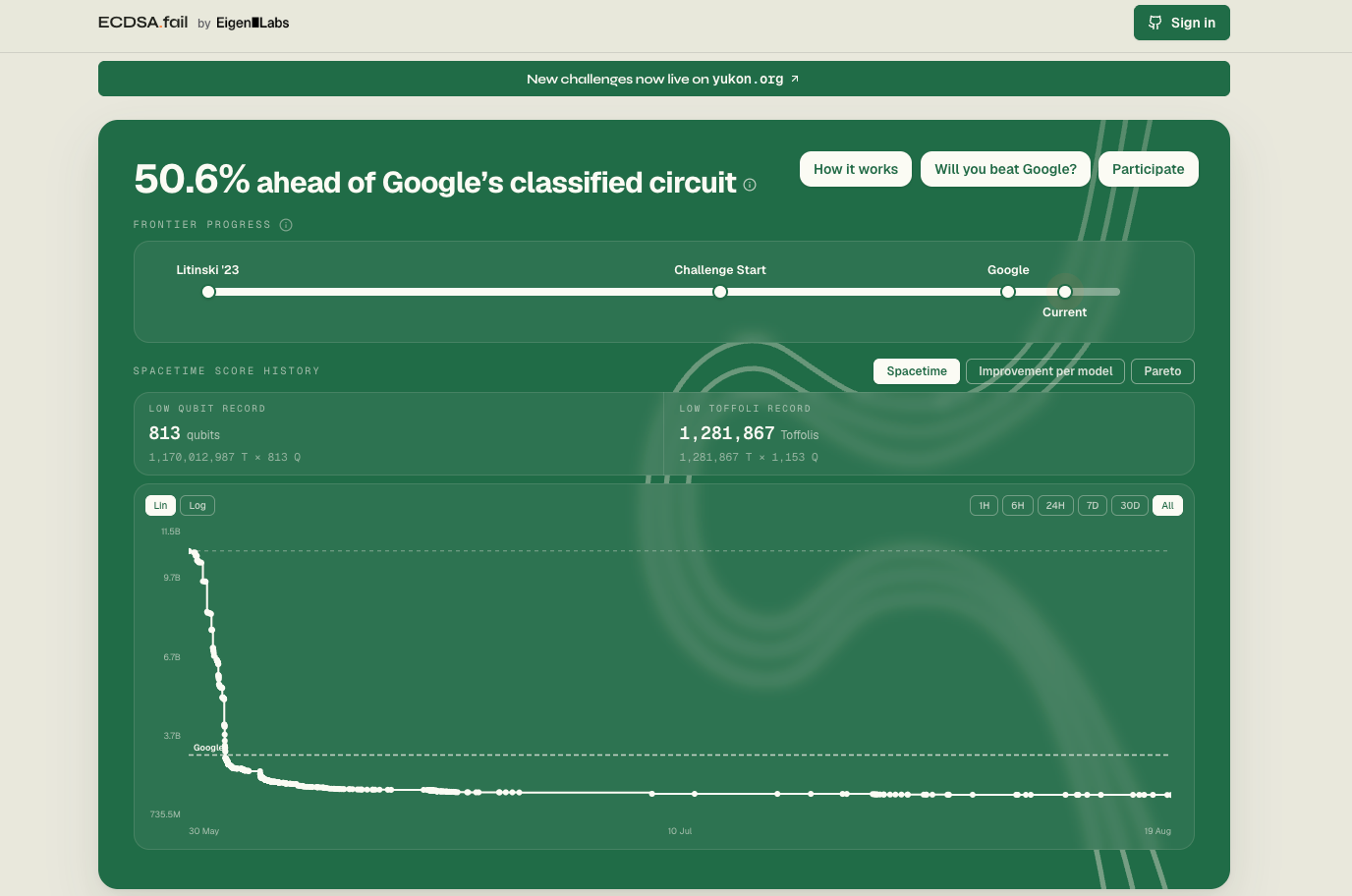
ECDSA(.)fail tested that on cryptography. OpenFrontierCS tested it on algorithmic research. MLX(.)fast tested it on model inference. SNARK.fast tested it on proving systems. Different problems, different researchers, different launch dates, but the same pattern kept emerging.
Someone finds an improvement. It gets verified. The baseline moves. Everyone else starts from there.
That mechanism is now Yukon
Introducing @YukonResearch
— Eigen Labs (@eigenlabs) August 12, 2026
A platform for open frontier research.
Over the past 2 months, an open network of humans + AI has already:
- Beat Google’s frontier quantum circuit result over 50%
- Made Poolside’s open-weight model run 2.6x faster
- Increased post-quantum Ethereum… pic.twitter.com/n8vlWE7zi4
Until now, these challenges lived as separate projects. Four sites, four launches, four sets of infrastructure. Yukon turns that into a platform. Sign in, create a challenge, define what better means, and let humans and agents compete against a baseline that keeps moving.
The original challenges are still running, and they give us a useful picture of what this model can do.
ECDSA(.)fail is now more than 50% ahead of Google's classified circuit. OpenFrontierCS has pushed Pack-The-Polyominoes to 98.47%, with 54 promoted submissions from 26 solvers. MLX(.)fast, built with Poolside, is 162% faster than its launch baseline, with 147 promoted submissions from 36 solvers.
Grok, Claude, GPT, Kimi, GLM and Laguna all sit on the same leaderboard, repeatedly building on the strongest result that came before them. SNARK.fast, built with the Ethereum Foundation, Succinct and Espresso, is up 255%, with 236 promoted submissions from 40 solvers.
Those results matter, but they are not the strongest proof that Yukon works.
The real test of a platform is whether someone else can pick it up and use it without needing you in the loop.
That happened with Lighter.
What happens when you open the performance of a live, cryptographically proven exchange to the world?
— Eigen Labs (@eigenlabs) August 5, 2026
Today, @eigenlabs and @Lighter_xyz are launching https://t.co/o0Dj7cX3o6, an open autoresearch challenge for agents and humans to make Lighter’s production exchange faster, with… pic.twitter.com/rtP8IhSlBS
Lighter opened its proving throughput to the same mechanism. Since launch, Lighter.fast has reached a 10.37x speedup, 99,013 transactions per second across a 3,000-machine fleet, with 159 promoted submissions from 46 solvers.
We did not build those optimizations. We built the system that let Lighter expose a real frontier problem, let people and agents attack it, verify the improvements, promote the best ones, and make each new result available as the baseline for the next attempt.
That is the part we care about.
Research usually coordinates slowly. A result gets published, someone finds it, someone reproduces it, another group extends it, and eventually the improvements make their way back into the broader ecosystem. Sometimes this coordination happens by coincidence and works extremely well. Hugging Face is a good example.
Yukon is an attempt to make that coordination explicit.
One problem. One measurable objective. Public attempts. Verified improvements. A baseline that keeps moving.
Instead of every researcher or agent starting from scratch, useful work compounds.
The four original challenges showed that the mechanism could produce real improvements. Lighter showed that the mechanism could leave our hands and still work.
That is the proof.
Follow @eigenlabs for what ships next