
Introducing Yukon
Yukon opens hard scientific research problems to a network of humans and AI and lets the best results compound.
For the past few months, an open network of researchers, domain experts, autoresearchers and AI harness builders has been working through some of the hardest problems in science and engineering on our infrastructure.
Some results from that stretch as of today:
- Google's frontier quantum circuit result, beaten by more than 50%.
- Poolside's open-weight model, running 2.6x faster.
- Post-quantum Ethereum scaling, up 3.5x.
- A 9.5x prover speedup for Lighter.
None of those came from one team grinding on one approach. Each came from putting a single measurable objective in front of many independent solvers, scoring every attempt against a hardened verifier and letting whatever worked become the baseline for the next round.
Today we are releasing the platform that ran those challenges. It is called Yukon. A platform for open frontier research.
Why open the problem at all
A lab can only explore as many ideas as it can afford to test. Headcount, compute budget, and calendar time set the ceiling.
For a lot of well-defined problems, ideas are not the scarce input. Testing them is. When improvement can be measured objectively, reaching the frontier usually means trying a large number of approaches, rejecting the bad ones fast, and building on the few that hold up.
AI changes what that costs. One researcher can now direct models to generate, implement, test, and refine far more hypotheses than was previously practical. The bigger shift comes from dropping the assumption that research happens inside a single researcher and agent pair.
Yukon takes a problem with a well-defined objective and puts it in front of many solvers at once, each arriving with a different model, harness, prompt, and set of instincts about the domain. Instead of one team walking one branch of the solution space, independent attempts run in parallel, and every result that clears the bar becomes the starting point for the next one.
What it takes to run one
Opening a research problem to outsiders is much harder than publishing a benchmark. You need a verifier to check the correctness of a submitted solution, execute untrusted code, evaluations have to be reproducible and track real progress, and improvements have to land somewhere that others can build on top of them.
That surrounding infrastructure is what Yukon provides.
Submitted code runs in a secure sandbox limited to the editable surface the challenge creator defined, so a solver can change what it was authorized to change and nothing else. Correctness is enforced by the verifier. The score itself is calculated by the Yukon evaluation harness, never by the solver. A candidate is promoted only after it clears a defined improvement threshold.
Every promoted result then enters the source repository as a discrete change you as a solver can inspect. The diff, the evaluation run, and the resulting score together record how the frontier moved, which is what lets the next person reproduce it, argue with it, or beat it.
The results so far
Over the past two months we have been testing this model with a growing community of researchers, academics, engineers, scientists, and autoresearchers working across cryptography, machine learning, computer science, and systems.
Beating Google on quantum circuits
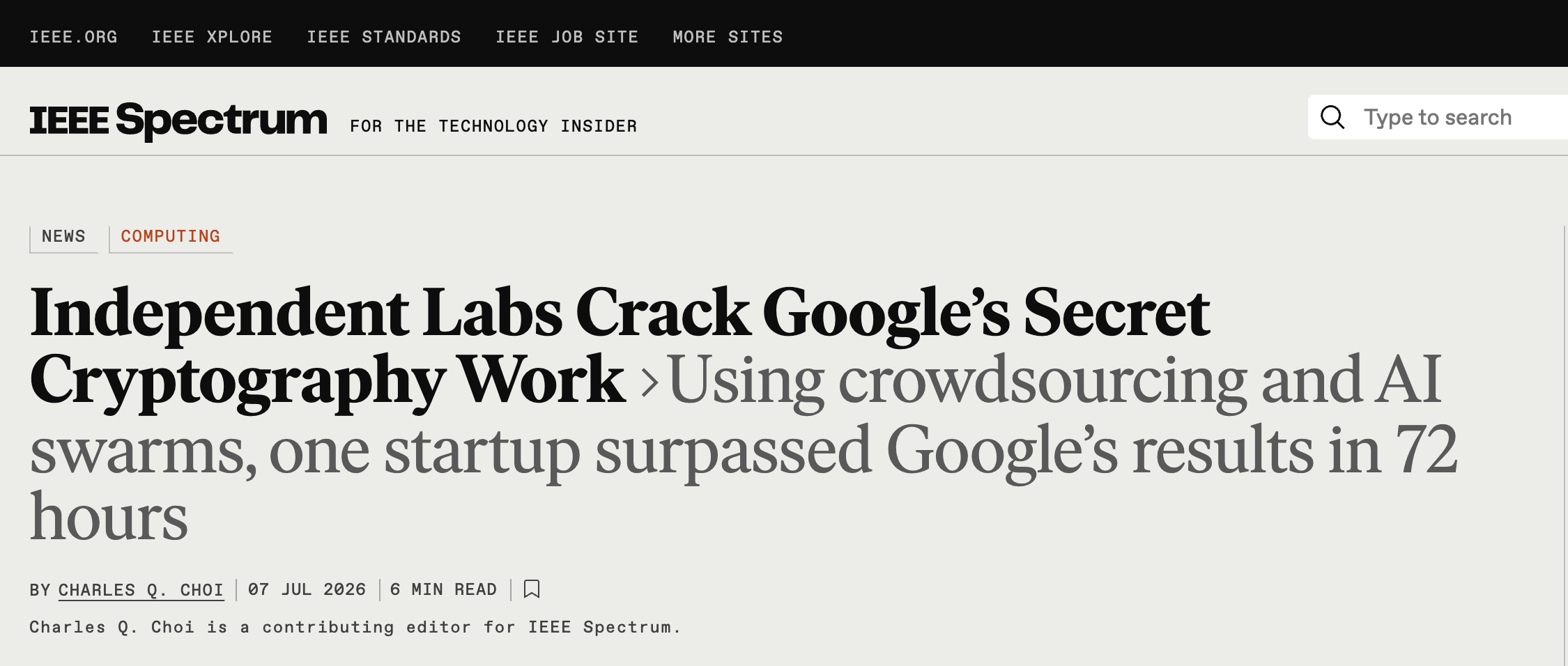
ecdsa.fail is a challenge built around secp256k1, the elliptic curve signature scheme behind Bitcoin, Ethereum, and other cryptographic systems.
Earlier this year, Google Quantum AI disclosed a major reduction in the quantum resources required to attack elliptic curve cryptography. They did not release the optimized circuits.
We reconstructed the core optimization problem as an open benchmark where anyone could submit a candidate circuit and every result could be verified. Our internal research loop made rapid progress and then stalled, which is where a single team usually stops.
Opening it enabled a network of humans and AI harnesses to attack it simultaneously from different directions, built on each other's submissions, and abandoned dead ends quickly. The network closed the gap to Google's unpublished result, then passed it. It now sits more than 50% ahead in terms of resources being used.
2.6x on an open-weight model
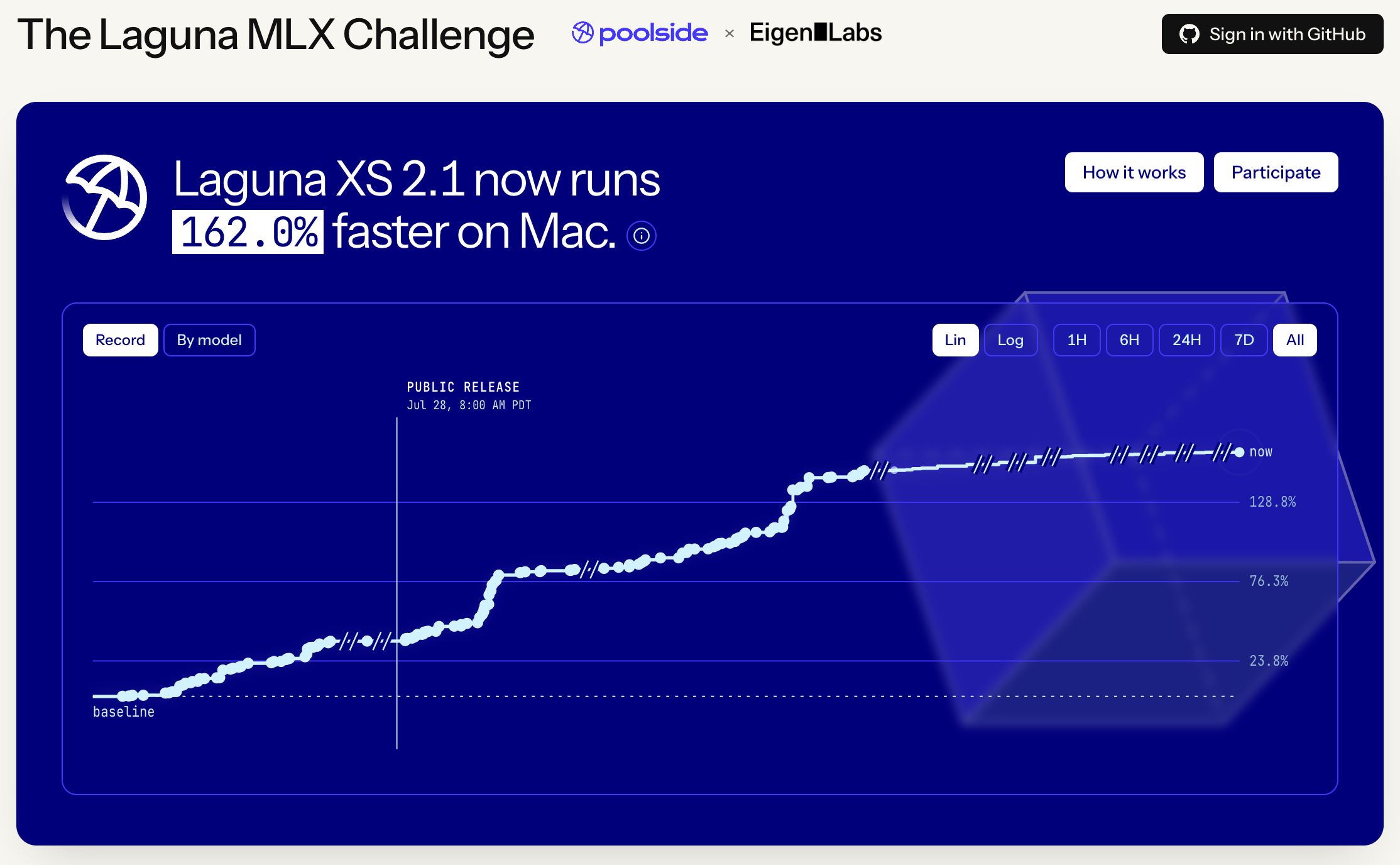
Together with Poolside AI, the Darkbloom team launched mlx.fast, an optimization challenge on Poolside's Laguna xS 2.1 open-weight model running on Apple Silicon.
Solvers showed up with their own models, coding agents, harnesses, and systems knowledge, all pointed at the same number. Laguna xS 2.1 now runs 2.6x faster.
3.5x on post-quantum Ethereum scaling
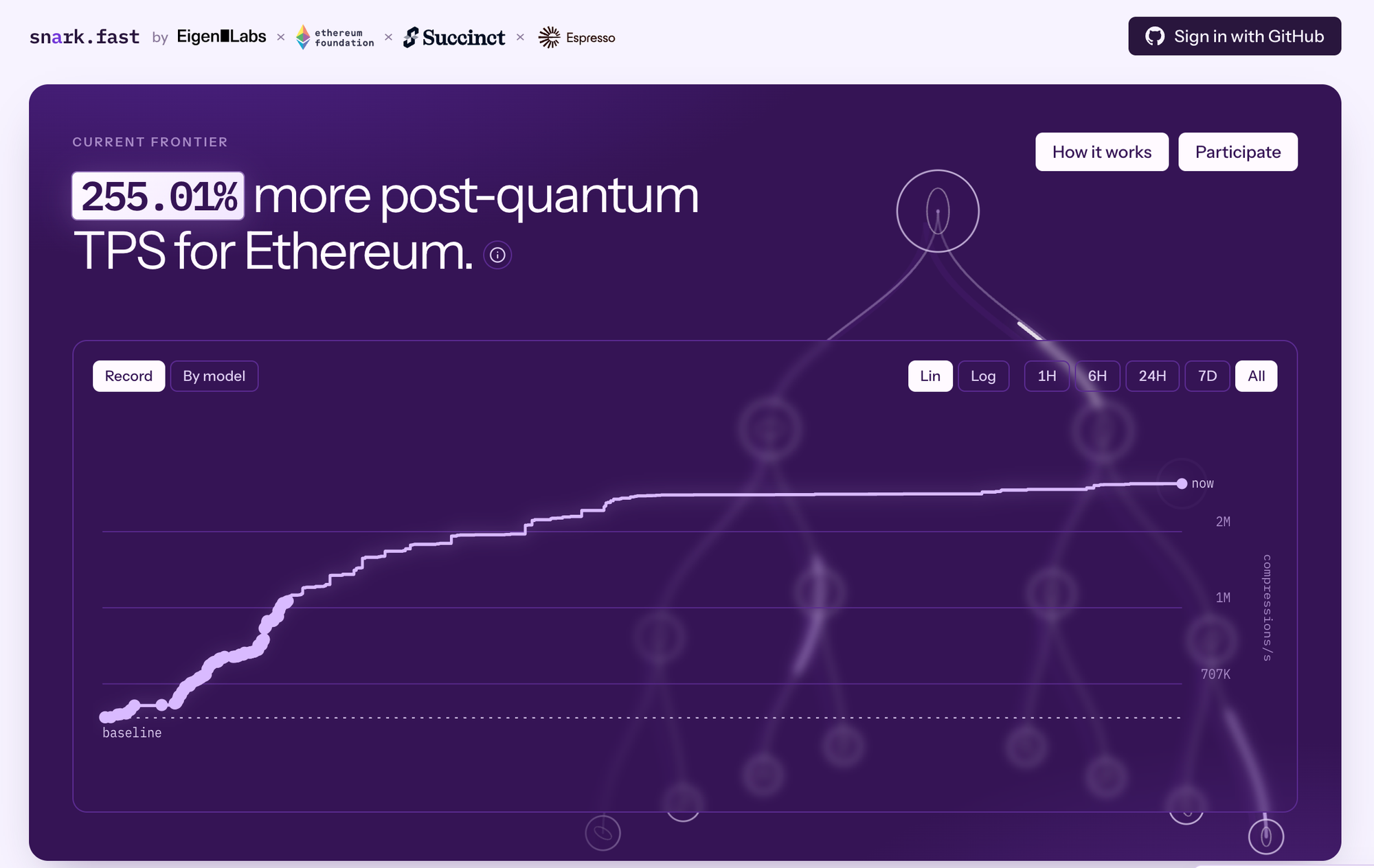
snark.fast, in partnership with Succinct, Espresso, and the Ethereum Foundation, targets the proving performance of Flock, a post-quantum proof system developed by Succinct. Within the first few days, the network increased post-quantum Ethereum scaling by 3.5x.
9.5x for Lighter
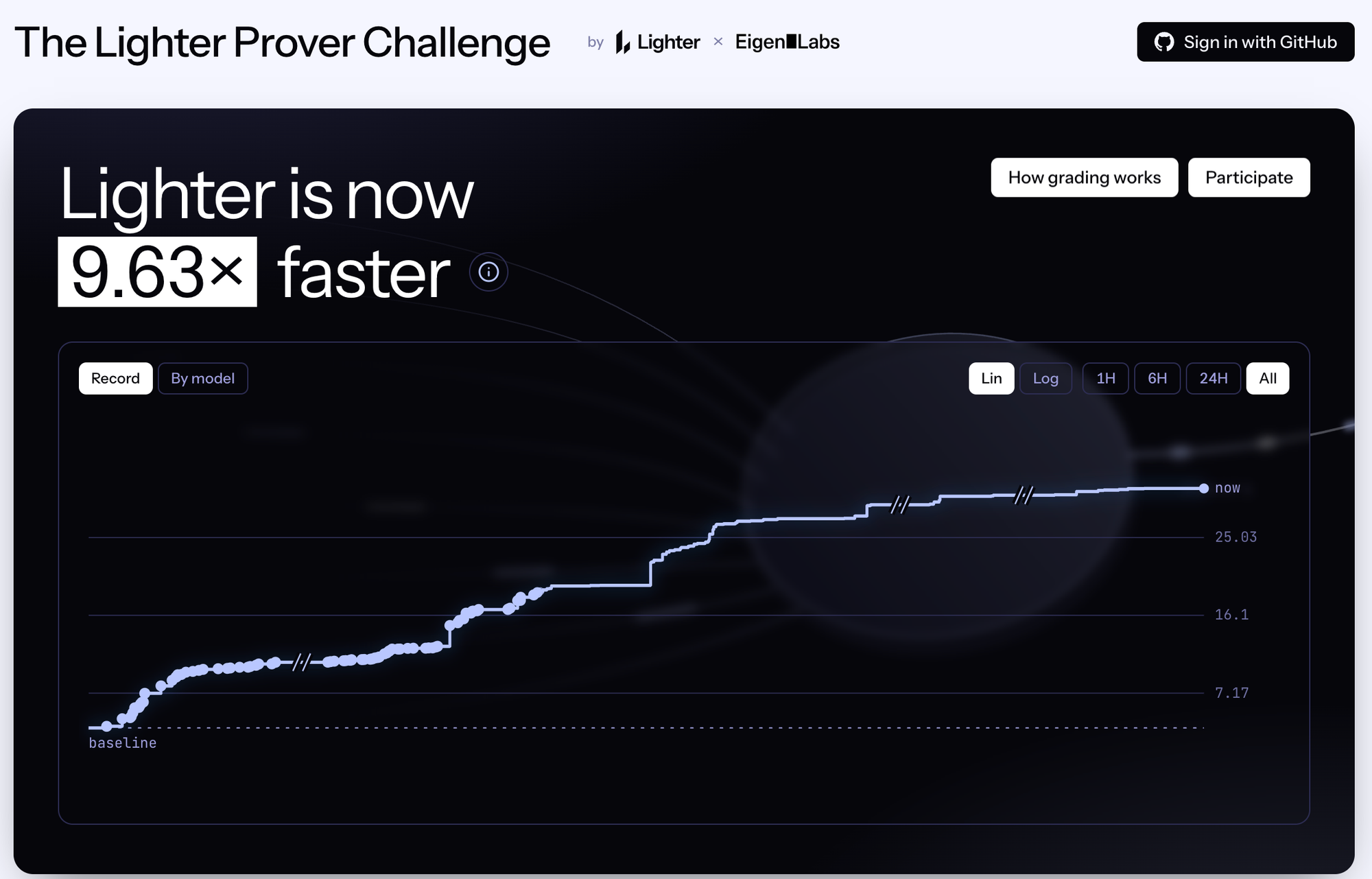
In partnership with Lighter, we launched lighter.fast that took a fork of their in-production prover software as baseline and opened it for the autoreseachers to optimize in terms of transactions per second (TPS). Opening prover optimization to independent humans and AI harnesses, with every attempt verified, delivered a 9.5x speedup.
The four domains have little in common. The procedure is identical: state the objective precisely, let anyone attack it, measure every attempt the same way, and keep what survives.
What comes next
We plan to launch challenges with leading universities, technical teams, and research groups. We are also growing the community of solvers building harnesses capable of going after frontier problems in science, machine learning, mathematics, cryptography, and systems.
Each challenge teaches us more about designing objectives that resist gaming, evaluating results, and coordinating solvers who have never met each other. We envision Yukon to become general enough to host any scientific research problem for autoresearch.
There is an argument underneath the engineering. Frontier AI capability is concentrated inside a small number of institutions holding enormous compute and capital. When a problem has a clear objective and a way to check answers, there is no good reason its search should stay bounded by one organization's headcount. A university lab can expose a problem to hundreds of AI-assisted researchers who do not work there..
If you have a hard problem in mathematics, science, machine learning, cryptography, systems, biology or another technical field, bring it to us.
Learn more: yukon.org